---
title: "Noble Protocol: The Asset Hub of the Cosmos Economy"
description: "A deep dive into Noble Protocol and its role in issuing and distributing native digital assets across Cosmos."
publicationDate: 2025-05-27
category: "Protocols"
authorName: "Lavneet Bansal"
featuredImage: "/images/blog/noble-protocol-asset-hub.webp"
draft: false
tags:
- "DeFi"
- "Modular"
- "Stablecoins"
---
## TL;DR:
**Noble is a dedicated blockchain that acts as a central hub for issuing and moving trusted digital assets, like USDC, across the Cosmos ecosystem, making asset transfers safer, simpler, and natively integrated without risky bridges.**
---
---
## 1. Introduction
Imagine the world of cryptocurrencies as a collection of bustling digital cities.
Each city, a blockchain, has its own economy, rules, and residents.
Moving money or valuable goods between these cities has always been tricky, often risky, and usually confusing.
You need special couriers ("bridges") who might charge extra fees, lose your package, or hand you back a version of your money that isn’t quite the same, and isn’t accepted everywhere.
Now imagine someone builds a specialized, highly secure central shipping hub, designed specifically to make moving certain valuable goods, especially stable digital dollars, seamless and safe across all cities.
**That’s what Noble Protocol aims to be for a network of interconnected blockchains in the Cosmos ecosystem.**
In simple terms:
Noble is a purpose-built blockchain whose main job is to **issue and distribute digital assets,** like USDC, **natively and securely** across dozens of other Cosmos chains.
It was created to solve a major headache: the lack of a reliable, trust-minimized way to use widely trusted assets across this growing "internet of blockchains."
Noble primarily serves two groups:
- **Asset issuers** - companies that create stablecoins or real-world assets
- **Developers** - building apps across Cosmos who need easy, secure access to these assets
In short:
> **Noble is building the monetary infrastructure that Cosmos' modular economy has long needed, replacing fragile workarounds with a native, seamless foundation.**
>
---
## 2. Problem and Market Context
**Why build a whole new blockchain just for issuing assets?** **The Problem of Digital Dollars Lost in Translation**
The answer lies in a few persistent problems that plagues the Cosmos ecosystem, a network of independent blockchains meant to communicate seamlessly, but often stumbling when it came to moving stable digital dollars.
Before Noble, bringing something like USDC onto a Cosmos blockchain usually meant relying on "bridges."
But this system had major flaws:
- **Security Risks**: Bridges lock up vast sums of real assets, making them tempting hacker targets. Many of crypto’s largest hacks exploited bridge vulnerabilities.
- **Liquidity Fragmentation**: Different bridges often issued their own slightly incompatible versions of the same asset (BridgeA-Dollar vs. BridgeB-Dollar), splitting liquidity and confusing users. It’s like having multiple gift cards for the same store, but none of them work together.
- **Poor User Experience**: Moving assets via bridges could be slow, costly (especially when sourced from congested chains like Ethereum), and error-prone, requiring users to juggle different token versions.
- **The Legacy of UST’s Collapse**: Cosmos had leaned heavily on a homegrown algorithmic stablecoin, UST (Terra Luna), until it collapsed catastrophically in 2022.
This shattered trust in native stablecoins and created urgent demand for fully-backed, reliable assets like USDC, but getting real USDC into Cosmos remained messy.
### Noble’s Role
Noble is built to address these pain points directly.
It offers a way for trusted assets like USDC to be **natively issued inside Cosmos**, using Cosmos’s own Inter-Blockchain Communication (IBC) standard, not external bridges or risky wrappers.
In short:
**Noble aims to replace fragile financial plumbing with safer, native-grade infrastructure, making stablecoins as seamless in Cosmos as they are in single-chain ecosystems.**
---
## 3. Architecture and Approach
**How Does Noble Work? A Peek Under the Hood**
Noble isn’t trying to be a blockchain that does everything.
It’s what Cosmos calls an **"appchain",** a blockchain built with the Cosmos SDK, designed for **one specific purpose: issuing digital assets**.
Think of it less like a general-purpose computer and more like a specialized piece of industrial equipment: focused, efficient, and built for a very particular job.
### Security and Operations
### Current Model: Proof-of-Authority (PoA)
Today, Noble operates like a secure facility guarded by a permissioned group of trusted entities, around 20 reputable validators$^1$, many of whom secure other major Cosmos chains.
Instead of staking a volatile token, their "stake" is their right to participate and earn future fees. Misbehavior (like approving fraudulent transactions) results in ejection and loss of income, a strong disincentive.
This Proof-of-Authority model prioritizes **stability and control**, critical when managing assets for institutional players like Circle, the issuer of USDC.
### Future Model: Interchain Security (ICS)
Over time, Noble plans to transition to **Interchain Security (ICS),** a system where it "borrows" the validator set and economic security of the Cosmos Hub itself.
In simple terms: Instead of relying on a small private guard, Noble will tap into the full security force of Cosmos’ largest chain.
However, this shift has been delayed.
Running on ICS costs real money (you must pay the Hub’s validators), and Noble’s current low-fee model, designed to encourage adoption, doesn't yet generate enough revenue to sustain it.
Thus, Noble faces a tension: **Growth first, decentralization later.**
### Key Features
- **IBC Native**: Noble is built around **IBC,** Cosmos’ standard "shipping protocol", allowing assets to move natively and seamlessly across the ecosystem.
- **CCTP Integration (Native USDC)**: Noble directly integrated Circle’s **Cross-Chain Transfer Protocol (CCTP)**. Unlike traditional bridges that lock tokens in contracts, CCTP **burns** USDC on the source chain and **mints** fresh USDC on Noble, a cleaner, trust-minimized model.
Noble was the **first non-Ethereum-style chain** to implement CCTP$^2$.
- **Packet Forwarding**: To prevent liquidity fragmentation, Noble uses **packet forwarding**.
When you send USDC from Chain A to Chain B, the transfer routes through Noble, ensuring the asset always looks natively minted, no "wrapped" or ambiguous versions floating around.
- **Noble Dollar (USDN)**:
Recently, Noble partnered with **M^0** to launch **USDN**, a new stablecoin backed by U.S. Treasury bills.
Unlike USDC (which is non-interest-bearing), USDN **passes yield** from T-bills back to holders and ecosystem partners, blending stablecoin usage with native yield generation.
### The Tradeoffs
Noble’s design reflects clear choices:
- **Centralization vs. Control**: Today’s PoA model favors security and speed for institutional adoption, but concentrates power among a small validator set.
- **Simplicity vs. Programmability**: By focusing solely on asset issuance, Noble can't host DeFi apps itself, but it makes stablecoins available for others to build on.
- **Adoption vs. Decentralization Timing**: Keeping fees low helps attract early integrations but delays the economic readiness needed for a full ICS migration.
> **Noble chooses to be boring, reliable infrastructure, at least for now, betting that composability and trust will matter more than flashy features in the long run.**
>
---
## 4. Innovation vs Iteration
Is Noble doing something radically new, or is it cleverly combining existing ideas?
Mostly the latter, but the combination and its application within Cosmos are meaningfully innovative.
### What’s Novel
- **Dedicated Hub Model**: Building an entire blockchain focused solely on neutral asset issuance, rather than general-purpose computation, is a first for Cosmos.
It carves out a distinct piece of modular financial infrastructure.
- **Native USDC via CCTP (Non-EVM)**: Bringing Circle’s **burn-and-mint mechanism** outside the dominant Ethereum ecosystem was a technical first, and a major milestone for Cosmos.
- **Yield-Bearing Stablecoin (USDN)**: Launching USDN, backed by U.S. Treasury bills and with **programmable yield distribution**, taps into the growing on-chain RWA (Real-World Assets) movement in a uniquely Cosmos-native way.
- **Packet Forwarding for UX**: A subtle but powerful improvement: automatically routing cross-chain stablecoin transfers through Noble itself to preserve native asset status, reducing friction for users without them needing to understand the underlying plumbing.
### What’s Iterative
- **Core Tech Stack**: Noble builds with familiar tools: Cosmos SDK, CometBFT consensus, and IBC, all standard, proven components within the ecosystem.
- **Appchain Philosophy**: Specializing a chain around one task fits squarely within Cosmos' broader modular appchain vision.
The idea itself isn’t new, the execution focus is what distinguishes Noble.
### Market Position
Noble stands as a **first mover for native USDC via CCTP in Cosmos**, and a **category creator** for clean, scalable asset infrastructure inside the ecosystem.
It doesn’t copy earlier models directly, it adapts known building blocks to **solve a localized, critical problem**.
> Noble didn’t invent the shipping container (IBC) or the global positioning system (CCTP).
>
>
> **It built a specialized infrastructure layer focused solely on efficient asset movement.**
>
In a growing modular economy, **infrastructure matters as much as innovation,** and Noble positions itself as the reliable dock every trader eventually needs.
---
## 5. Comparative Landscape
**How Does Noble Stack Up? Comparing the Options**
Before Noble, if you wanted USDC on a Cosmos chain, you typically used **bridged versions,** like **axlUSDC** (via Axelar Bridge) or **gravUSDC** (via Gravity Bridge).
These bridges served an important need, but carried serious tradeoffs.
### Noble’s Native Assets vs. Bridged Assets
| Feature | Noble (Native USDC, USDN) | Bridged Assets (e.g., axlUSDC) |
| --- | --- | --- |
| **Type** | Native (Original) | Wrapped (Voucher) |
| **Risk Source** | Issuer (e.g., Circle) + Noble Chain Security | Bridge Security + Bridge Operator Behavior |
| **Fungibility** | High (Uniform across Cosmos chains) | Fragmented (Bridge-specific variants) |
| **Mechanism** | Burn/Mint via CCTP, Direct Issuance | Lock/Mint (Assets locked on source chain) |
The biggest differences boil down to **trust and fungibility**.
With Noble’s native USDC, users trust:
- The issuer (Circle) to back the stablecoin properly
- The Noble chain’s security to maintain asset integrity
With bridged USDC, users must trust:
- The bridge operators not to get hacked
- The smart contracts holding locked funds to be invulnerable, a tall order historically
Bridges accumulate **large honeypots of locked assets**, making them prime hacker targets.
Noble’s CCTP-based burn-and-mint model sidesteps this risk by avoiding locked funds entirely.
Packet forwarding also means Noble-issued USDC **retains its identity** across Cosmos chains, preventing the liquidity fragmentation seen with different bridged variants.
### Noble’s Strategic Focus
Importantly, Noble isn’t trying to replace general-purpose bridges like Axelar or Wormhole.
Bridges will always be needed for moving a wide variety of tokens across ecosystems.
Instead, Noble **specializes**:
It acts as the trusted issuance hub for **foundational assets** like USDC and USDN inside Cosmos.
Its goal isn’t to compete with DeFi platforms like Osmosis or trading hubs like dYdX, it’s to **power them**, by becoming the default stable liquidity layer they can build upon.
> **Noble focuses on direct, composable asset transfers rather than traditional bridges.**
>
---
## 6. Protocol Metrics and Financials
**By the Numbers: Traction, Funding, and Finances**
Ideas are important, but usage is the real test.
So how is Noble actually performing out in the wild?
### Asset Flow
Noble has quickly become a **major conduit for real-world assets entering Cosmos**.
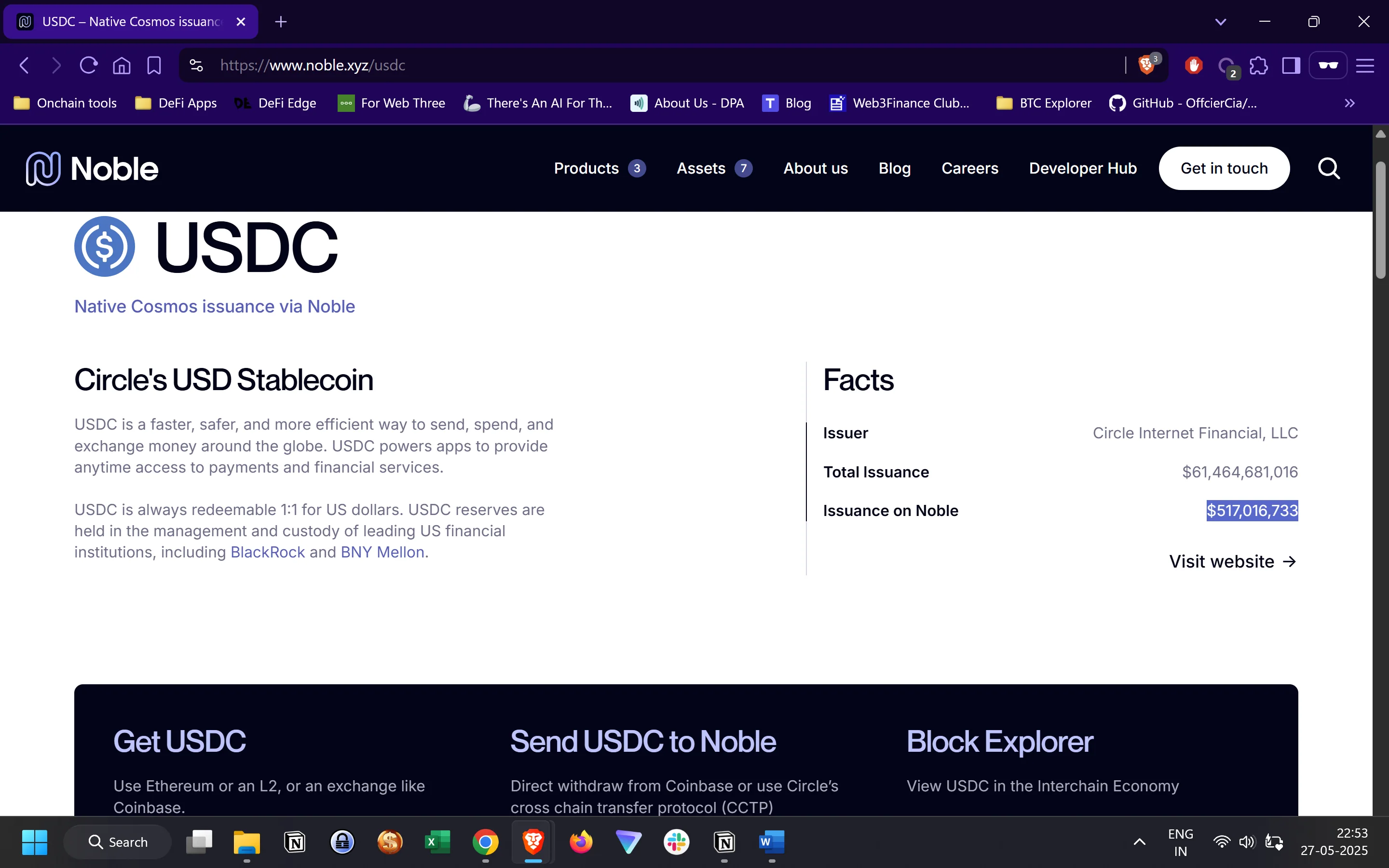
- **USDC (Circle-issued)**: Noble is now the **primary native minting hub for USDC** inside Cosmos. As of May 27, 2025 , approximately **$517 million** worth of USDC has been minted through Noble. $^3$
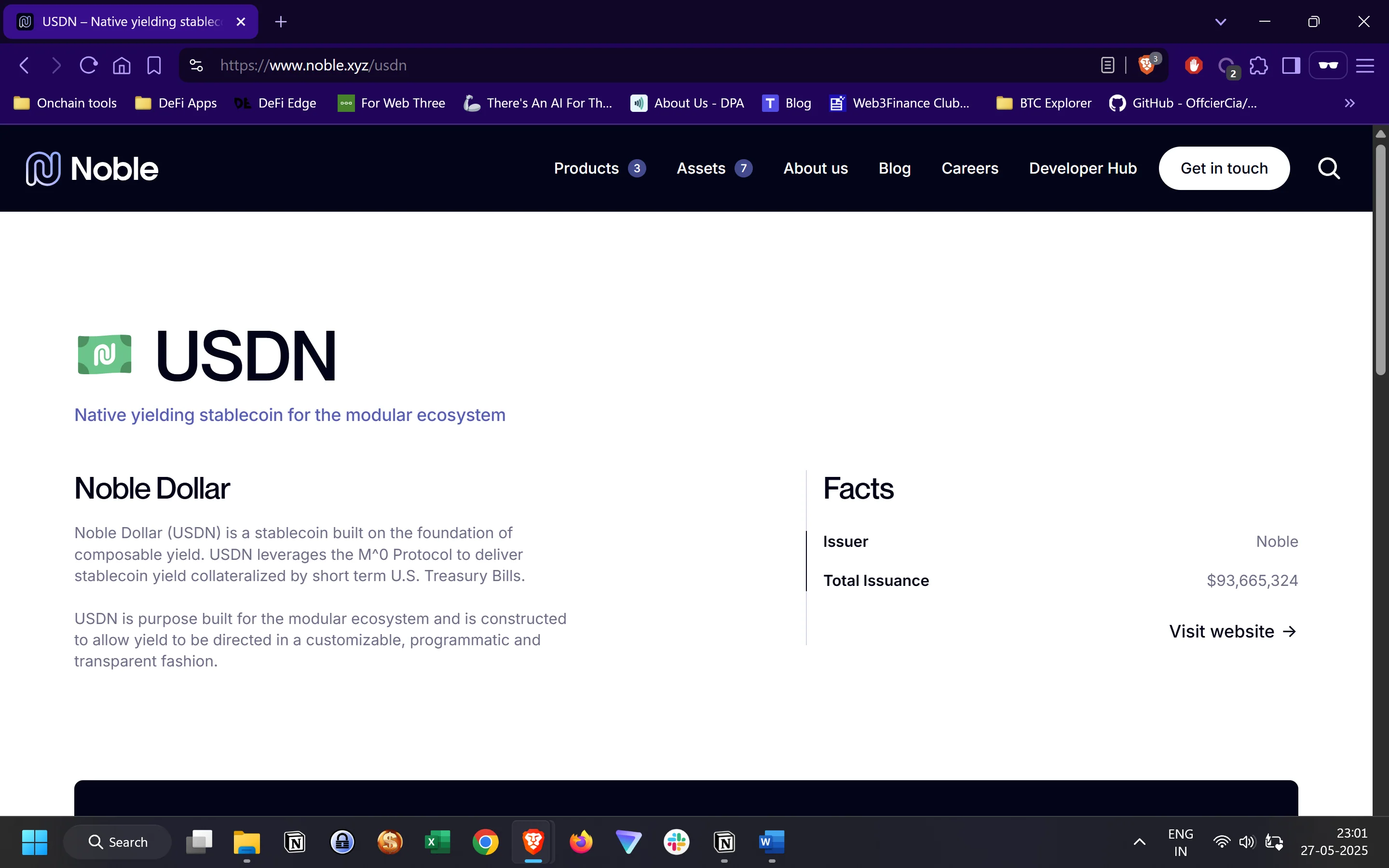
- **USDN (Noble Dollar via M^0 Partnership)**: USDN, backed by U.S. Treasuries and offering native yield, has seen total issuance of **$93 million** since launch, signaling early but rising interest in real-world asset-backed stablecoins inside Cosmos. $^4$ $^5$
- **USDY (Ondo’s US Dollar Yield Token)**: Noble also facilitated the launch of **USDY**, a USD yield product from Ondo.
Current issuance stands around **$15 million**, broadening Noble’s footprint beyond stablecoins into on-chain securities.
**In total**, Noble-connected assets have moved **billions in cumulative transaction volume** across Cosmos since launch, although the majority remains concentrated in USDC flows.
### Protocol Revenue
Here’s where reality bites:
- **Transaction fees** on Noble are kept deliberately **near-zero** to encourage early adoption.
- As a result, **direct protocol revenue is minimal.**
While great for user growth, this low-revenue model explains why **transitioning to ICS** (shared security via Cosmos Hub) has been slower. Noble would need a sustainable revenue stream to afford securing itself through external validators.
### Funding
Despite limited fee revenue, Noble has secured **substantial venture backing**:
- **$3.3M Seed Round** – Led by Polychain Capital
- **$15M Series A$^6$** – Led by Paradigm
Total funding raised: **$18.3 million**.
Strategic investors include Circle Ventures, Wintermute Ventures, and others. Backing from heavyweight investors suggests strong industry belief in Noble’s strategic positioning, not just as an appchain, but as foundational infrastructure for Cosmos' financial flows.
### Real Usage vs. Speculation
Unlike many DeFi launches that chase speculative TVL spikes, Noble’s adoption looks **genuinely infrastructure-driven**:
- **dYdX v4,** the largest decentralized derivatives exchange, relies heavily on Noble-minted USDC for trading margin and settlements.
- **Cross-chain DeFi apps** like Osmosis and Kujira have begun treating Noble USDC as the "default dollar" in liquidity pools, lending markets, and auctions.
This usage suggests **sticky, functional demand** rather than short-term farming games.
In short:
**Noble’s traction isn’t measured in yield APYs. It’s measured in integrations and dollar flows.**
---
## 7. Token Design and Incentives
**Does Noble Have Its Own Coin? Token Talk**
One of Noble’s most important early decisions: **It launched without a native protocol token.**
There’s no separate "NOBLE" token used for paying fees or staking, at least for now.
### Current State
- **Transaction Fees**: Paid in accepted assets like **USDC** or **ATOM** (Cosmos Hub’s native token).
- **Validator Staking**: Current PoA validators use **non-economic participation tokens,** purely to verify membership, not to secure the network economically.
### Future Token Hints
With the launch of USDN came the **Noble Points program,** where users can lock USDN to earn points tied to a future Noble protocol token. This mirrors common strategies used by other protocols:
**Bootstrap early adoption, reward loyal users, and tee up governance decentralization.**
The writing is on the wall:
A native Noble token is likely coming, tied to governance, incentives, and potentially funding security upgrades like ICS.
---
## 8. Team, Ecosystem, and Support
**Behind the Curtain: The Builders and Backers**
At the heart of Noble is a team blending Web3 expertise, traditional finance experience, and technical depth, backed by heavyweight investors and strategic partners across the blockchain ecosystem.
### The Founders
- **Jelena Djuric (CEO)**:
A veteran of Web3 policy and blockchain advocacy, Jelena previously co-founded the Canadian Web3 Council and worked across ecosystems like Cosmos, Dfinity, and Celo.
She brings a strong background in regulatory engagement, critical for building stablecoin infrastructure aimed at institutional adoption.
- **Stefan Coolican (COO/CFO)**:
With a background in investment banking and capital markets, Stefan served as President and CFO at Ether Capital before Noble.
His traditional finance experience shapes Noble’s operational discipline and strategic financial positioning.
- **John Letey (CTO)**:
A deep technical mind, John previously co-founded KYVE (a decentralized data storage protocol) and contributed to multiple crypto projects across Arweave and Ethereum.
His engineering leadership anchors Noble’s secure, minimalist blockchain design.
Together, they represent a rare blend:
**Policy-savvy, financially literate, and technically credible.**
### Partners
On the partnership front, Noble’s ecosystem is tightly woven into both the supply and demand sides of the Cosmos economy:
- **Supply-Side Partners**:
- **Circle** (native USDC issuance)
- **M^0** (USDN, yield-bearing stablecoin initiative)
- **Hashnote** (USYC, tokenized T-bills)
- **Ondo Finance** (tokenized bonds integration)
- **Demand-Side Integrations**:
- dYdX v4 (perpetuals trading)
- Osmosis (decentralized exchange)
- Sei (high-speed trading chain)
- Injective (DeFi derivatives)
- **Infrastructure Support**:
- **Strangelove Ventures** (IBC relaying)
- Wallets like **Keplr** and **Leap** for asset management and user experience.
**Summary**:
With a technically strong founding team, A-list backers, and deep integration into Cosmos’ growing modular economy, Noble isn’t operating in isolation.
It’s positioned right at the center of Cosmos’ push toward institutional-grade financial infrastructure.
---
## 9. Roadmap and Delivery
**Roadmap Check-In: Delivering on the Vision**
Noble’s early roadmap focused on building core infrastructure, and so far, it has delivered most key milestones on a strategic, if slightly flexible, schedule.
### What’s Shipped
- **Mainnet Launch**: *March 2023,* Noble blockchain went live, focused solely on asset issuance.
- **Native USDC via IBC**: *April 2023,* First minting of Circle-issued USDC natively on Noble, available across Cosmos chains via IBC.
- **CCTP Integration**: *August 2023,* Noble became the first non-EVM blockchain to integrate Circle’s Cross-Chain Transfer Protocol (CCTP), enabling seamless burn-and-mint USDC transfers.
- **Native RWA Issuance (USYC via Hashnote)**: *November 2023,* Launch of tokenized U.S. Treasury-backed stable asset (USYC) on Noble.
- **Launch of USDN (Noble Dollar)**: *February 2024,* Introduction of USDN, a yield-bearing stablecoin, along with the Noble Points program to bootstrap early participation.
Each milestone cemented Noble’s growing role as Cosmos’ trusted monetary infrastructure.
### What’s Next
- **Transition to Interchain Security (ICS)**: Migration delayed from initial 2024 target, pending sufficient revenue growth to afford ICS validator fees sustainably. (*Expected H2 2025)*
- **USDN Upgrades**: Full IBC compatibility for USDN to facilitate broader DeFi usage and composability across Cosmos chains. (*Expected Mid-2025* )
- **Cross-Ecosystem Asset Transfers (CCTP Router Feature)**: Potential launch of a routing upgrade for CCTP, simplifying asset movement across both Cosmos and external ecosystems. (*Expected Late 2025)*
*(Note: Some "expected" dates are based on public team communications and are subject to revision.)*
### New Development: AppLayer Launch on Celestia
In addition to expanding asset issuance inside Cosmos, Noble has announced plans to launch a new project: **AppLayer**$^7$**,** a high-throughput, stablecoin-native rollup built on **Celestia’s modular data availability (DA) layer**.
Slated for launch in **Q3 2025**, AppLayer represents an important expansion of Noble’s infrastructure strategy.
While the existing Noble chain focuses narrowly on secure asset issuance, AppLayer will introduce **programmability** and **smart contract capabilities,** creating a dedicated environment for developers building tools and financial applications optimized for stablecoins and real-world assets (RWAs).
Key features of AppLayer include:
- Leveraging **Celestia’s modular architecture** for cheaper, more scalable data storage.
- **Ethereum-compatible execution** for broader smart contract interoperability.
- Targeting DeFi projects, financial tooling, and RWA integrations that demand higher throughput than Cosmos chains currently offer.
By building atop Celestia’s DA layer, Noble can offer a **parallel settlement environment,** complementing, rather than replacing, its current Cosmos-native asset issuance chain.
In strategic terms:
**Noble is evolving from purely issuing stablecoins into enabling their full programmable usage, across modular blockchains.**
If successful, AppLayer could extend Noble’s influence well beyond Cosmos into the broader modular finance landscape.
### Delivery Track Record
While not every milestone landed precisely on its original timeline, notably the ICS migration, Noble’s team has delivered most major initiatives without overpromising.
Crucially, the team has maintained **transparency** around delays, particularly emphasizing the economic realities that slowed security upgrades.
Overall, Noble’s execution reflects strategic patience:
**Build stable foundations first. Scale security and modularity once usage justifies it.**
---
## 10. Community and Governance
**Who Makes the Rules? Governance and Control**
Noble’s governance today is deliberately centralized. A choice made to prioritize stability and trustworthiness during its early partnerships with major issuers like Circle.
### Current Model: Proof-of-Authority + Multisig Control
The chain is operated under a **Proof-of-Authority (PoA)** model:
- A **small, permissioned validator set,** about 20 trusted entities$^1$, handles block production and transaction validation.
Oversight and upgrades are coordinated by the **Noble Maintenance Multisig (NMM),** a **5-of-7 multisignature** setup that:
- Proposes software upgrades (validators retain final approval rights).
- Directly implements network parameter changes, like transaction fee settings.
- Includes members from the Noble team and key validator partners.
This structure allows Noble to move quickly and maintain tight control over technical changes, crucial during sensitive integrations like CCTP and asset launches.
### Risks of the Current Setup
The tradeoff is clear:
**Power is concentrated among a small group.**
This creates specific risks:
- **Multisig compromise**: If the NMM wallet were compromised, critical governance functions could be hijacked.
- **Validator collusion**: A few entities acting in bad faith could undermine network operations.
- **Operational dependency**: Heavy reliance on Noble’s founding company (**NASD Inc.**) could pose bottlenecks if leadership shifts or strategic priorities change.
In short:
**Noble is fast and stable today, but not yet credibly decentralized.**
### Future Governance: Moving Toward ICS
The long-term plan is to migrate Noble’s security and governance model to **Interchain Security (ICS)** under the Cosmos Hub.
Once this happens:
- Block production would be handled by **the full Cosmos Hub validator set**.
- Major upgrades and governance decisions would flow through **ATOM token holder voting,** significantly increasing decentralization and reducing single-entity control.
However, the migration timeline remains contingent on Noble generating sufficient protocol revenue to pay ICS validators sustainably.
Until then, Noble remains in a transitional phase:
**A centralized steward today, aiming to become a decentralized utility tomorrow.**
---
## 11. UX and Developer Experience
**User Friendliness: Smooth Sailing or Choppy Waters?**
Since Noble is primarily backend infrastructure, its "user experience" isn’t about flashy apps or slick frontends.
Instead, it's about making life easier for **developers integrating assets,** and by extension, creating **seamless liquidity experiences** for end users across Cosmos.
### For Developers
Noble is built with **familiar Cosmos SDK tooling**, meaning developers don’t need to learn exotic new frameworks to interact with it.
Cross-chain transfers are made simple and automatic through **IBC integration** and **packet forwarding**, ensuring that assets like USDC maintain their native status as they move between chains.
The **CCTP integration** adds another layer of ease. Instead of relying on risky bridges, developers can now enable burn-and-mint native USDC issuance with minimal complexity.
Combined with **near-zero transaction fees**, Noble offers a frictionless environment for projects managing liquidity or stablecoin flows.
### For End Users (Indirectly)
Although end users rarely interact with Noble directly, they benefit downstream from the design choices:
- **Fast transactions** (secured by CometBFT consensus) mean low-latency operations on integrated platforms like Osmosis and dYdX.
- **Seamless liquidity movement** across Cosmos appchains improves trading, lending, and general DeFi experiences.
- **Trusted brand associations,** with Circle, M^0, and Hashnote, enhance user confidence in the assets issued through Noble.
- **Wallet support** from major players like **Keplr** and **Leap** ensures easy access and usability without complicated setups.
In short:
**Noble focuses on making the complex invisible, letting developers handle stablecoins cleanly, so users never have to worry about where their dollars came from.**
---
## 12. Go-To-Market Strategy
**Spreading the Word: Noble’s Growth Playbook**
Noble’s growth strategy is less about splashy marketing and more about **embedding itself into the foundations** of the Cosmos economy.
Rather than chasing casual retail users, Noble focuses on becoming **essential infrastructure** that builders and liquidity providers quietly depend on.
### The Core Playbook
- **Partnerships with Major Asset Issuers**:
Noble’s early strength came from securing cornerstone partnerships, like Circle (USDC), M^0 (USDN), and Hashnote (USYC), to mint trusted assets natively inside Cosmos.
- **Deep Integrations with Key Application Chains**:
Rather than launching user-facing apps itself, Noble plugged into major chains like dYdX (perpetuals trading), Osmosis (DEX liquidity), Sei (high-speed trading), and Injective (DeFi derivatives), becoming their preferred stablecoin infrastructure layer.
- **Leveraging the IBC Network**:
By tapping into Cosmos’ native Inter-Blockchain Communication (IBC) protocol, Noble gained **instant interoperability** with dozens of chains, without needing costly, custom one-to-one integrations.
- **Targeted Incentive Programs**:
Launching the **USDN Points Program** incentivized early stablecoin adoption and hinted strongly at future Noble token airdrops, a classic but effective strategy to bootstrap liquidity and reward early backers.
### The Organic Growth Engine
Beyond direct partnerships, Noble’s organic growth comes from **solving a real pain point**: delivering native stablecoins without the trust risks of bridges or synthetic wrappers.
By positioning itself as **neutral monetary plumbing,** not a flashy app or a competitor to DeFi projects, Noble avoids friction with other builders and quietly becomes indispensable.
Its messaging is targeted:
- Speak to **developers** who need seamless stablecoin integration.
- Support **liquidity providers** who value composable, native assets.
- Build trust through **stability and utility**, not hype.
In short:
> **Noble’s go-to-market isn’t loud, it’s quietly foundational.**
>
---
## 13. Legal and Regulatory Considerations
**The Legal Landscape: Navigating Choppy Waters**
Noble operates in one of the most heavily scrutinized corners of crypto: stablecoins and tokenized real-world assets (RWAs).
With global regulators circling, maintaining legal resilience is critical, but not fully within Noble’s direct control.
### Jurisdiction
The company behind Noble, **NASD Inc.,** is headquartered in **Canada**, giving it access to relatively stable North American regulatory frameworks.
However, by issuing assets globally across decentralized networks, Noble is inevitably exposed to legal regimes worldwide, from U.S. stablecoin oversight to evolving European MiCA regulations.
### Token-Related Risks
- **Future Noble Token**: If Noble eventually launches a native protocol token (hinted at via the Noble Points program), its regulatory classification, **security, commodity, or utility,** will be crucial. Token design choices will heavily influence this risk profile.
- **Issued Assets**:
- **USDC** already faces intense scrutiny around reserve management, money transmission licensing, and audit standards.
- USDN and USYC, because they are yield-bearing and backed by U.S. Treasury bills, could face higher risks of being treated as securities under U.S. and similar financial regulations.
While the SEC recently clarified that fiat-backed stablecoins, fully collateralized by low-risk assets like cash and Treasuries and used purely for payments, would generally not be considered securities, this exemption likely does not cover yield-bearing stablecoins.
As a result, products like USDN and USYC, which offer returns to holders, may still fall under securities regulations despite their asset backing.
Even if Noble itself remains a neutral infrastructure provider, the nature of the assets it issues magnifies regulatory exposure.
### Partner Risks and Compliance Dependencies
Noble’s compliance posture is tightly linked to its key partners:
- If **Circle**, **M^0**, or **Hashnote** encounter regulatory issues, whether around licensing, reserve audits, or securities law challenges, it would directly disrupt Noble’s ability to issue and distribute stable assets.
- While Noble likely works closely with partners to maintain AML/KYC standards where necessary, ultimate compliance liabilities often **flow through the issuers**, not the infrastructure.
This partner dependence is both a strength, bringing trusted brands into Cosmos, and a vulnerability.
**Summary**:
Even if Noble plays by the rules itself, **the regulatory fate of its ecosystem partners could heavily shape Noble’s future.**
In modular financial ecosystems, **legal exposure becomes as composable as technology.**
---
## 14. Design Philosophy and Tradeoffs
**Design Choices: Why Build It This Way?**
Noble’s architecture reflects a deliberate, pragmatic philosophy, shaped by the unique realities of modular blockchains and stablecoin issuance.
At every step, the team made conscious tradeoffs between **security, simplicity, composability, and decentralization speed**.
### What Noble Optimized For
From the beginning, Noble prioritized:
- **Security and Trust**: Launching under a centralized PoA validator set and multisig governance to offer predictable stability for early asset issuers like Circle.
- **Interoperability**: Deep IBC integration and seamless CCTP minting made it easy for assets to move across Cosmos chains without fragmenting liquidity.
- **Simplicity and Specialization**: Noble deliberately avoided becoming a general-purpose smart contract platform, focusing entirely on clean, native asset issuance.
- **Ease for Asset Issuers and Developers**: By positioning itself as **neutral financial infrastructure**, Noble made itself attractive to builders who needed stable liquidity, not another competitive ecosystem.
### The Tradeoffs
But these optimizations came with real costs:
- **Centralization Today for Decentralization Tomorrow**: Noble accepted concentrated early control through its PoA validator set and multisig, betting that credibility with partners mattered more at launch than full decentralization.
- **Low Fees, Slower Security Upgrades**: Keeping transaction costs near zero helped adoption, but left Noble with limited revenue, delaying its ability to afford an ICS migration for more decentralized security.
- **Heavy Partner Dependency**: Noble’s early success is closely tied to a few major issuers (Circle, M^0, Hashnote). Diversification will be key to reducing systemic risk over time.
### A Composability-First Vision
At its core, Noble is **designed to disappear into the background,** offering native assets like USDC, USDN, and USYC as reliable building blocks for DeFi across the Cosmos economy.
Instead of trying to be the star of the show, Noble aims to be the invisible infrastructure other projects can trust and build upon.
**In one line**:
**Start stable. Specialize narrowly. Decentralize sustainably.**
It’s not the fastest way to grow, but in Cosmos, slow and composable may win the long game.
---
## 15. Narrative Fit
**Riding the Crypto Waves: Where Noble Belongs**
Noble fits cleanly into several of the major narratives shaping blockchain development today, making its existence feel not just logical, but almost inevitable.
### Tapping Into Major Trends
- **Interchain/Multichain Future**:
Noble is built on the assumption that **no single blockchain will dominate,** and that seamless asset movement across sovereign networks like Cosmos will be critical.
- **Native Stablecoins Demand**:
After years of bridge hacks and wrapped token confusion, the crypto industry is moving toward **native stablecoins,** safe, composable dollars minted directly inside ecosystems, exactly the role Noble plays for USDC and USDN.
- **Real-World Assets (RWA) Boom**:
By issuing tokenized, T-bill-backed assets like USYC and USDN, Noble plants itself squarely inside the growing on-chain RWA movement.
- **Modular Blockchain Architecture**:
As appchains, sovereign rollups, and modular execution layers proliferate, **liquidity rails** become as important as data availability, and Noble positions itself as **the monetary backbone** for modular ecosystems.
- **Yield-Bearing Stablecoins**:
USDN taps into a newer emerging trend: programmable, yield-distributing dollar substitutes that blend stability with on-chain earnings potential.
In short:
Noble isn’t inventing new categories, it’s strategically slotting itself into **where real crypto infrastructure is heading anyway.**
### Brand Positioning
Noble presents itself not as a consumer-facing project, but as **invisible but indispensable financial infrastructure**.
Its messaging focuses on:
- **Security**
- **Interoperability**
- **Composability**
- **Neutrality**
This ethos resonates especially well within Cosmos' technical, builder-driven culture, where infrastructure is valued more for **how quietly and reliably it works** than how loudly it markets itself.
---
## 16. Risks and Limitations
**Danger Zones: Where Noble Could Stumble**
Despite strong execution so far, Noble faces meaningful risks, many rooted in its external dependencies and modular design.
### Technical and Infrastructure Risks
Noble relies on multiple critical systems functioning correctly:
- Vulnerabilities in its own codebase, the Cosmos IBC protocol, Circle’s CCTP infrastructure, or partner platforms like M^0 could disrupt stablecoin issuance and asset transfers.
- Consensus failures or upgrade errors could threaten network operations, particularly at scale.
### Economic and Market Risks
Noble’s economic sustainability depends on asset demand and revenue generation:
- A major stablecoin event, such as a **USDC depeg** or a collapse of **USDN** or **USYC,** could rapidly fracture DeFi liquidity across Cosmos.
- Continued low transaction fees, while good for adoption, could delay migration to Interchain Security (ICS), prolonging reliance on centralized Proof-of-Authority (PoA) governance.
- A collapse in appetite for tokenized RWAs could reduce demand for Noble’s issued assets.
### Operational and Centralization Risks
During its PoA phase, Noble carries concentrated operational risk:
- The **Noble Maintenance Multisig (NMM)** represents a critical governance chokepoint; compromise could disrupt upgrades or parameter changes.
- Overreliance on a small set of validators and relayers introduces potential bottlenecks if key participants fail or behave maliciously.
### Regulatory and Partner Risks
Even if Noble’s own infrastructure remains compliant, it depends on partner institutions facing intense regulatory scrutiny:
- Regulatory action against **Circle**, **M^0**, or **Hashnote** could directly impair Noble’s ability to issue or support core stable assets.
- Emerging stablecoin rules, especially around yield-bearing instruments like USDN, could tighten legal constraints, forcing operational changes or restricting market access.
**Summary**:
Noble’s modular position gives it agility and reach, but also amplifies fragility.
Its critical dependencies, stable issuers, cross-chain infrastructure, regulatory clarity, must hold steady for Noble to realize its full potential.
---
## 17. First-Principles Thinking & Second-Order Effects
**Stress-Testing Noble’s Assumptions; For Better and Worse**
At its core, Noble’s model depends on a network of external systems, partners, and market assumptions.
Understanding Noble’s trajectory means not just evaluating its design, but stress-testing what happens when its critical assumptions are either upheld or broken.
### Core Assumptions
Noble’s success hinges on a few structural bets:
- **Partner Stability**: Circle, M^0, and Hashnote remain solvent, compliant, and operational.
- **Infrastructure Reliability**: Cosmos IBC maintains secure, scalable communication across chains.
- **Persistent Asset Demand**: Appetite for tokenized dollars and RWAs (USDC, USDN, USYC) stays strong.
- **Decentralization Path Execution**: Migration to Interchain Security (ICS) happens without major disruption.
Each assumption is critical, not optional.
### If Assumptions Break: Risk Cascades
- **Stablecoin Disruptions**: A USDC depeg or collapse of USDN/USYC would fracture liquidity across Cosmos DeFi, freezing many applications reliant on Noble-issued assets.
- **IBC Failure**: Downtime or exploits would halt asset transfers, breaking Noble’s composability promise and isolating chains.
- **ICS Delay**: Prolonged reliance on centralized PoA governance could erode Noble’s credibility with institutional partners.
- **Regulatory Divergence**: Fragmented global stablecoin rules could entangle Noble’s asset issuance in complex multi-jurisdiction compliance hurdles.
### If Assumptions Overperform: Positive Network Effects
- **Critical Monetary Layer**: Noble could solidify itself as the trusted stablecoin and RWA settlement layer across Cosmos, difficult to displace once deeply embedded.
- **Cross-Ecosystem Expansion**: With CCTP and IBC, Noble-issued assets could bridge cleanly into Ethereum, Solana, and L2 ecosystems without fragmented liquidity.
- **Regulatory Advantage**: If Circle, M^0, and Hashnote maintain compliance leadership, Noble’s assets could become the “safe default” across modular finance.
- **Accelerated Decentralization**: Surging adoption and fees could allow faster ICS transition, boosting security and governance decentralization earlier than planned.
- **Programmable Yield Growth**: If USDN succeeds, Noble could position Cosmos at the forefront of stable, yield-bearing on-chain dollars, ahead of Ethereum’s yield markets.
### Second-Order Thinking: Fragility and Opportunity
Modular ecosystems amplify both failure and success.
Small breaks in dependencies can cascade into systemic shocks, but small successes can snowball into market dominance.
Noble’s design multiplies both outcomes.
It lives at the edge, where composability magnifies upside if dependencies hold, and magnifies fragility if they falter.
**Bottom Line**:
Noble’s modular architecture doesn't just carry assets.
It carries risk, and responsibility, across every system it touches.
Success demands not just execution excellence, but resilience across an interconnected web of partners, users, and infrastructure.
---
## 18. Closing Thoughts
**Where Noble Stands After First-Principles Scrutiny**
Stepping back, Noble emerges as one of the most strategically positioned, yet structurally dependent, infrastructure projects inside the modular blockchain landscape.
It isn’t trying to dominate with apps or liquidity mining.
It’s trying to become the invisible foundation other ecosystems quietly depend on.
### What's Exciting
- **Real-World Problem Solving**: Noble addresses a genuine gap: secure, native stablecoins without bridges or synthetic wrappers.
- **Technical Precision**: Integrations like IBC packet forwarding and CCTP burn/mint aren’t experimental, they are surgical solutions to deep liquidity fragmentation issues.
- **Strong Strategic Alignment**:
Circle, Paradigm, and Polychain support underscores Noble’s positioning as critical, neutral monetary infrastructure.
- **Narrative Tailwinds**:
Noble rides directly atop durable trends, modular blockchains, cross-chain liquidity, and tokenized real-world assets (RWAs).
### What Still Needs Proving
- **Decentralization Execution**: Transitioning from PoA to ICS will be the critical milestone for long-term credibility.
- **Sustainable Economic Model**: Building consistent fee revenue or alternative funding structures to secure operations and validators under ICS remains an open challenge.
- **Regulatory Navigation**: Managing exposure to evolving stablecoin and RWA regulations, particularly around yield-bearing assets like USDN, will require strategic agility.
- **Managing Systemic Dependencies**:
Noble’s reliance on upstream asset issuers and infrastructure (Circle, M^0, Hashnote, IBC) must be actively monitored and diversified over time.
### Overall Assessment: Composable but Interdependent
Noble is best understood as **Composable but Interdependent Infrastructure**.
It solves a vital problem, executes with technical focus, and fits neatly into the emerging modular blockchain economy.
But its success is braided tightly into external systems, Cosmos, Circle, cross-chain standards, RWA adoption trends.
If Noble decentralizes cleanly, sustains its economics, and remains resilient to upstream shocks,
it has the potential to become a foundational monetary pillar for modular finance.
But in modular ecosystems, the same composability that creates opportunity also multiplies fragility.
Noble will rise, or strain, based not just on what it controls, but on how well it navigates everything it doesn’t.
---
---
## Footnotes
1. Cosmos Hub Forum, “Noble: ICS v1 Update” - [https://forum.cosmos.network/t/noble-ics-v1-update/12312](https://forum.cosmos.network/t/noble-ics-v1-update/12312)
2. Noble Blog, “Announcing CCTP on Noble - Enabling Easy Access to USDC” - [https://www.noble.xyz/blog/announcing-cctp-on-noble](https://www.noble.xyz/blog/announcing-cctp-on-noble)
3. As mentioned on the Noble’s website on page [https://www.noble.xyz/usdc](https://www.noble.xyz/usdc)
1. Noble Blog, “Noble Dollar, $USDN, is LIVE!” - [https://www.noble.xyz/blog/introducing-usdn](https://www.noble.xyz/blog/introducing-usdn)
2. As mentioned on the Noble’s website on page - [https://www.noble.xyz/usdn](https://www.noble.xyz/usdn)
1. Noble’s announcement on X - [https://x.com/noble_xyz/status/1858879397622579302](https://x.com/noble_xyz/status/1858879397622579302)
2. Coindesk, “ Noble’s New ‘AppLayer’ Lets Developers Build Stablecoin Tools on Celestia“ - [https://www.coindesk.com/tech/2025/04/15/noble-s-new-applayer-lets-developers-build-stablecoin-tools-on-celestia](https://www.coindesk.com/tech/2025/04/15/noble-s-new-applayer-lets-developers-build-stablecoin-tools-on-celestia)
Originally published through Hiraku Research, an independent long-form research project I previously ran.